How Are Frying Pans Measured?
If you’ve ever walked into a kitchen store or scrolled through cooking websites, you’ve probably seen frying pans labeled with numbers like 8-inch, 10-inch, or 12-inch. But what do these numbers actually mean? How do you know if a pan is the right size for your needs? This guide breaks down everything you need to know about frying pan measurements in simple, easy-to-understand terms.
In this article
What Do Frying Pan Sizes Actually Mean?
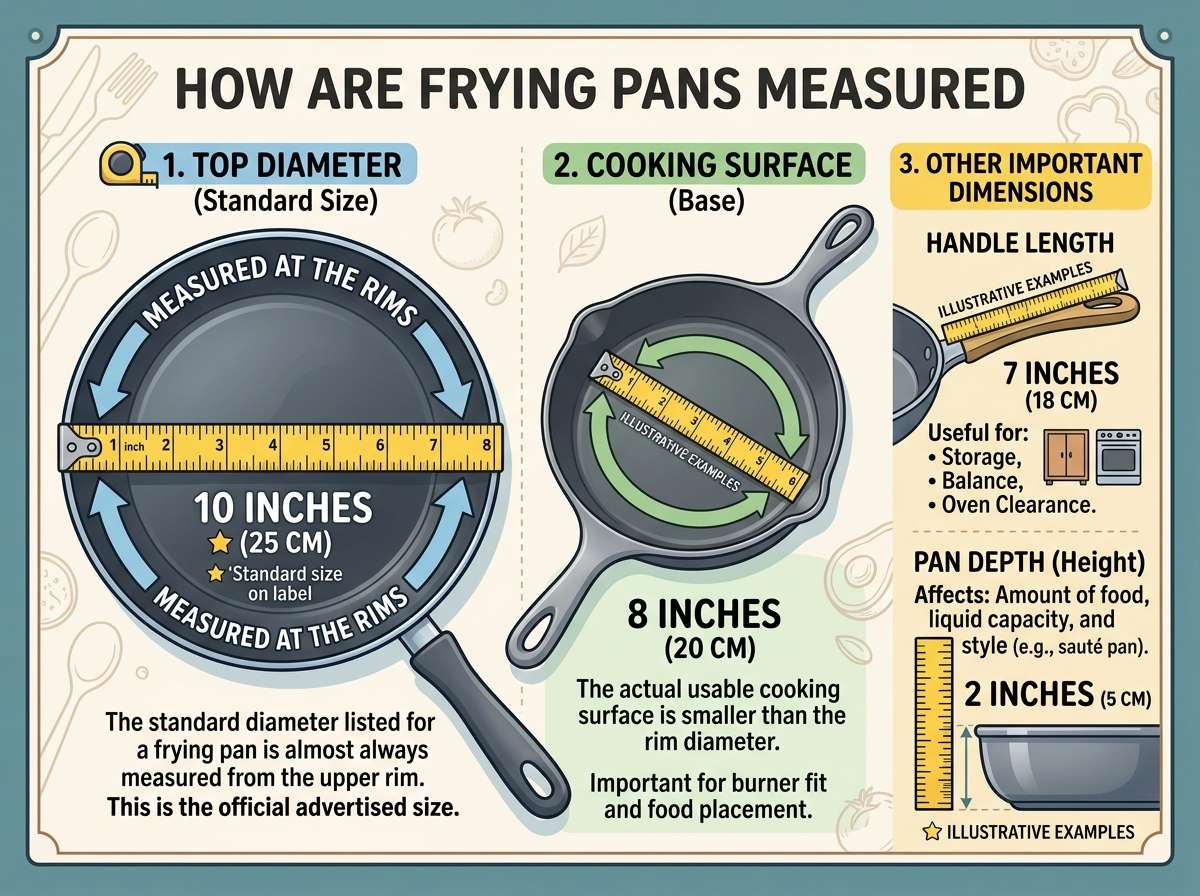
The first thing to know is that frying pan sizes refer to the diameter of the pan. When a store says a pan is 10 inches, they’re talking about how wide the pan is measured across the top opening.
Think of it this way: if you laid a ruler across the widest part of the pan’s opening, a 10-inch pan would measure 10 inches from one side to the other. This measurement is the most important detail when it comes to pan size.
The diameter is measured from the inside edge of the rim to the opposite inside edge of the rim. It’s not about the outer dimensions or the handle. Just the actual cooking surface at the top of the pan.
The Common Frying Pan Sizes You’ll Find
When you go shopping for frying pans, you’ll notice they come in standard sizes. Knowing these standard options helps you understand what you’re looking at:
Small frying pans typically measure 6 to 8 inches across. These tiny pans work great for cooking just one or two eggs, melting butter, or making a grilled cheese sandwich. They’re perfect if you’re cooking for yourself or one other person.
Medium frying pans range from 9 to 10 inches. This is probably the most popular size in home kitchens. A medium pan can handle cooking breakfast for two or three people, sautéing vegetables for dinner, or browning meat for a sauce.
Large frying pans go from 11 to 12 inches across. These big pans let you cook for a larger group all at once. You can fry several pieces of chicken, cook pancakes for a family, or stir-fry a big batch of vegetables without crowding the surface.
Extra-large frying pans can be 14 inches or even bigger. These commercial-size pans are less common in home kitchens but super useful if you cook for large groups regularly or have a lot of family members to feed.
How Depth Plays a Role Too
While diameter is the main measurement, the depth of the pan also matters for certain cooking tasks.
Shallow frying pans have sides that are only about 1 to 1.5 inches tall. These are best for tasks like pan-frying, sautéing, or making flat dishes like eggs and pancakes. The shallow sides make it easy to flip food and slide things onto a plate.
Deeper frying pans can have sides that go up to 2.5 or even 3 inches. These deeper pans work better for braising, cooking foods with sauces, or frying items that might splatter. The extra depth helps keep oils and liquids contained while you cook.
Some people call deeper pans “sauté pans” to tell them apart from shallow frying pans. But honestly, the line between a frying pan and a sauté pan gets a bit blurry. The important thing is knowing whether you need shallow or deep sides for your cooking style.
Understanding Bottom Diameter vs. Top Diameter
Here’s something that surprises many people: not all frying pans are straight-sided. Some pans have sloped or curved sides, which means the bottom of the pan is actually smaller than the top.
When you see a size listed, it always refers to the top diameter. This is what matters most because that’s where you put your food. The bottom might be a half-inch to an inch smaller, but this doesn’t change how the pan is labeled.
This is why it’s good to check the actual bottom if you’re buying a pan in a store. Feel the difference between the top and bottom. For most home cooking, this difference doesn’t matter much. But if you’re working with a tight stovetop or specific cookware, it’s worth knowing.
Measuring Your Current Frying Pans
Maybe you already own some frying pans and want to know their exact size. Measuring is super easy.
You’ll need a ruler or measuring tape. Lay the ruler straight across the inside of the pan at the widest point, going from the inner edge of the rim on one side to the inner edge on the opposite side. Read the number where the ruler reaches. That’s your pan’s diameter size.
It’s that simple. No fancy tools required. Most pans will measure to a nice round number like 8, 10, or 12 inches. Some pans might measure closer to 9.5 inches, which stores often round to 10 inches for simplicity.
If you’re shopping online and the listing doesn’t give a size, but you see a photo with a ruler or common object for scale, you can estimate the width. This isn’t as accurate as the actual measurement, but it gives you a ballpark idea.
Why Pan Size Matters for Your Cooking
The size of your frying pan affects how your food cooks. This is important to understand because it changes the results you get in your kitchen.
Crowding your pan happens when you fill a small pan with too much food. If you dump four chicken breasts into an 8-inch pan, they’ll be stacked on top of each other. The food steams instead of frying because the pieces can’t get direct contact with the hot surface. You end up with soggy, pale food instead of nicely browned pieces.
Having too much empty space in a large pan also causes problems. If you’re cooking two eggs in a 14-inch pan, the butter burns in the areas far from the eggs. You lose control over the temperature and timing. Small amounts of food can cook unevenly.
The sweet spot is having enough room so your food spreads out in a single layer with a bit of breathing room between pieces. This lets the heat reach everything evenly.
How to Pick the Right Size for Your Household
The best pan size depends on how many people you usually cook for and what you like to make.
If you live alone or cook mostly for yourself: An 8-inch pan is all you need. It heats up fast, uses less oil, and handles everything from eggs to steak. It’s also easier to clean and store.
If you cook for two to three people regularly: Go with a 10-inch pan. This is the workhorse of most home kitchens. It’s big enough to cook multiple servings at once but not so massive that it wastes heat when cooking smaller amounts.
If you have a larger family or entertain often: A 12-inch pan becomes really valuable. You can handle bigger quantities and won’t need to cook in batches as often.
If you like having options: Many cooks keep two pans on hand. A 10-inch and an 8-inch pair handles almost every home cooking situation. When one is in the sink, you have a backup. When you need different sizes for different tasks, you’ve got them ready.
Materials and How They Affect Measurements
Different materials used to make frying pans don’t change how you measure them. A cast iron 10-inch pan is still 10 inches across, just like a stainless steel one is.
However, the material can affect how the pan feels when you use it and how long it lasts. Cast iron pans tend to be heavier, which affects how easy they are to handle. Non-stick pans slide food around easily but can wear out over time. Stainless steel pans are durable but require more skill to use well.
The material also changes how well the pan distributes heat. Copper bottoms heat faster. Aluminum spreads heat more evenly. But when you’re looking at the label in the store, the number is still just the top diameter measurement.
Comparing Frying Pans to Other Cookware
It helps to know how frying pans fit in with other kitchen pots and pans.
A frying pan has a wide, flat bottom and relatively shallow sides. This shape is perfect for cooking foods that need to make contact with hot metal.
A skillet looks basically the same as a frying pan. Honestly, these two words get used interchangeably most of the time. Some people think skillets are slightly deeper or have curved sides, but the measurements work the same way.
A sauté pan is usually deeper and sometimes has straight sides. It’s measured the same way (top diameter) but holds more liquid, so it works better for dishes with sauces.
A wok is measured differently. Since woks are round-bottomed and cone-shaped, there’s no standard diameter system like frying pans have.
A Dutch oven or large pot is also round, but it’s so deep that diameter alone doesn’t tell the whole story. Stores usually mention both diameter and depth for these bigger pieces.
Knowing these differences helps you make sense of cookware labels when you’re shopping.
Standard Measurement Systems
The US primarily uses inches to measure frying pan size. If you see an 8-inch pan, it’s 8 inches in diameter.
In countries using the metric system, you might see centimeter measurements instead. A 20-centimeter pan is roughly equivalent to an 8-inch pan. A 28-centimeter pan is close to an 11-inch pan.
If you’re ordering cookware from international sellers, knowing how to convert helps. Here are some quick comparisons:
- 6 inches = about 15 centimeters
- 8 inches = about 20 centimeters
- 10 inches = about 25 centimeters
- 12 inches = about 30 centimeters
Most online stores show both measurements now, which makes shopping easier for everyone.
Reading Pan Labels and Product Information
When you’re shopping for frying pans, knowing how to read the label tells you what you actually need to know.
The size number is always prominently displayed. It’s the biggest or most obvious number on the package. This is the diameter we’ve been talking about.
Some labels also mention the capacity. This tells you how many cups or milliliters the pan can hold. A 10-inch pan usually holds about 2 to 2.5 quarts of liquid. This is useful to know if you make sauces or anything involving liquid.
The weight is sometimes listed too. Heavier pans usually hold heat better but are harder to lift. Lighter pans heat up faster but might have hot spots.
Material composition is important. “Non-stick,” “cast iron,” “stainless steel,” or “hard anodized aluminum” tells you what the pan is made of and how to care for it.
Some labels mention oven-safe temperature. This tells you whether the pan can go in the oven and at what temperature. Handles matter for this. Metal handles can go hotter than plastic or silicone ones.
Reading all this information helps you buy exactly what you need instead of being confused by fancy marketing language.
How Restaurant and Commercial Pans Are Sized
If you’ve ever watched cooking shows or been in a restaurant kitchen, you might notice their pans look different.
Commercial pans follow the same basic sizing system, but they tend to be on the larger side. Restaurant kitchens typically use 10, 12, and 14-inch pans. They rarely use anything smaller because they’re cooking for many people.
Commercial pans are usually made from different materials too. They’re built to handle constant use and high heat. The construction is heavier, so the pan costs more but lasts longer.
Many home cooks love commercial-style pans because they feel sturdy and professional. You can buy them online or at restaurant supply stores. Just know they might be pricier than standard home cookware.
Why Manufacturers Label Pans the Way They Do
You might wonder why frying pans use a simple diameter measurement when other cookware sometimes uses different methods.
The answer is historical and practical. Frying pans have been made for centuries with a simple flat bottom and sloped sides. The diameter was always the most important measurement because it directly relates to how much food fits and how it heats.
Manufacturers keep using this simple system because it works. Everyone understands what “10-inch” means. It’s universal. It doesn’t change based on depth or material or brand.
This consistency actually helps you as a buyer. You can compare pans from different brands easily. A 10-inch pan from Brand A will have basically the same cooking surface as a 10-inch pan from Brand B. The brand difference shows up in quality and price, not in the basic measurement.
Special Pan Sizes and When You Might Need Them
Beyond the standard small, medium, and large sizes, you might encounter some unusual options.
7-inch pans sometimes show up for specialty cooking. They’re useful for making small omelets or searing single steaks. But they’re not common enough to find easily.
9-inch pans are interesting because they’re between medium and large. Some cooks love them because they offer a middle ground. They’re not too big or too small.
11-inch pans exist but are less popular than the round numbers. An 11-inch is basically a huge 10-inch, so most people just go with 12-inch if they want something really big.
14-inch and 16-inch pans are huge. These commercial-size pans work great if you love cooking big batches or have lots of people to feed. They can be hard to handle and store, though.
If you’re just starting your cookware collection, stick with the standard sizes. Once you know your preferences, you can add specialty sizes if you need them.
Storage and Space Considerations
Pan size affects how much cabinet space you need. This matters when you’re thinking about which pan to buy.
An 8-inch pan takes up minimal space. You can fit several of them in a compact cabinet or hang them on a small wall rack.
A 10-inch pan is standard size. Most kitchens can accommodate these without trouble.
A 12-inch pan is noticeably bulkier. If you have small cabinets or limited kitchen space, storing a 12-inch pan might be challenging. You might need to hang it on a wall or keep it on the stove.
Many people solve this by using hanging racks or magnetic strips on walls. These let you display your pans and keep them accessible without eating up cabinet space.
When you’re deciding which size pan to buy, think about where you’ll actually keep it. A gorgeous 12-inch pan doesn’t help if you have no room to store it.
How to Test if a Pan Size Will Work for You
Before you commit to buying a specific size, you can test it if you already have pans in other sizes.
Borrow a pan from a friend in the size you’re thinking about. Use it for a week. Cook your normal meals. See if you like how much it holds and how it handles. This real-world test shows you whether that size is right for your cooking style.
Pay attention to questions like: Do you feel like you have enough space? Do you struggle to lift it? Does it heat the way you want? These practical details matter way more than what some review says online.
If you can’t borrow a pan, watch videos of people cooking in different sizes. See how much food goes in and how they use the space. This gives you a visual sense of whether you think you’d like that size.
Updating Your Knowledge When You See Pan Prices
You’ll notice that pan prices jump around a lot. Sometimes the same size pan from different brands costs wildly different amounts.
The diameter measurement itself doesn’t change the price. A 10-inch pan from an expensive brand and a 10-inch pan from a budget brand are the same width. What changes is the material quality, brand reputation, non-stick coating durability, handle comfort, and how long the pan will last.
A cheap 10-inch pan might warp after a year of heavy use. An expensive 10-inch pan could last decades. Both are 10 inches, but your experience and long-term value differ.
Understanding that size and price are separate things helps you shop smarter.
Quick Reference Guide to Frying Pan Sizes
Let’s create a simple reference you can come back to:
6-inch pans: Solo cooking, melting small amounts, precise tasks. Heats very fast. Easy to store.
8-inch pans: Perfect for one person or a small couple. Handles basic cooking well. Great second pan.
10-inch pans: The most popular size. Works for 2-3 people. Versatile for most cooking tasks. Standard home kitchen size.
12-inch pans: Large family cooking. Great for batch cooking. Impressive and professional-looking. Takes more space.
14+ inch pans: Commercial kitchens or serious cooks. Rarely needed at home. Requires strong wrists and good storage.
This simple guide helps you understand which size fits your life.
Final Thoughts on Frying Pan Measurements
Measuring a frying pan is simple once you know what you’re looking at. It’s just the diameter across the top, nothing more complicated than that.
The size you choose depends on how many people you cook for, what kind of food you make, and how much space you have. There’s no single “best” size for everyone. The best pan is one that works for your cooking style and fits your kitchen.
Start with a 10-inch pan if you’re unsure. It’s the most versatile size and handles almost every cooking task. Once you cook in it for a while, you’ll know if you want to add a smaller or larger size to your collection.
Don’t overthink it. Frying pans are tools, and like any tool, the most important thing is that you enjoy using it. The measurement is just the starting point for finding your perfect pan.
Now you can walk into any kitchen store or browse cookware websites with confidence. You understand what those numbers mean and how to pick the right pan for your needs. Happy cooking!

Mary is a home cooking enthusiast and kitchen appliance reviewer who loves helping people find the best tools for everyday meals. She enjoys testing air fryers, deep fryers, and other cooking appliances while sharing honest reviews and practical buying advice. Through FryerPick.com, Mary provides expert guides, product comparisons, and cooking tips to help readers choose the right fryer for their kitchen.