Air Fryer Skewer Rack Guide
If you love juicy kebabs, grilled veggies, or skewered meat but don’t want to fire up an outdoor grill every time, an air fryer skewer rack might be the tool you’ve been missing. This handy little accessory turns your air fryer into a mini rotisserie station, letting you cook skewers evenly on all sides without flipping them by hand every few minutes.
In this guide, we’ll walk through what an air fryer skewer rack actually is, why it’s worth adding to your kitchen, how to use one the right way, and tips to get the best results every single time. By the end, you’ll know exactly how to pick one and how to use it like a pro.
In this article
What Is an Air Fryer Skewer Rack?
An air fryer skewer rack is a small accessory that fits inside your air fryer basket or drawer. It holds wooden or metal skewers in place while they cook, and many models come with a built-in rotation feature. That means the skewers slowly spin as the hot air circulates around them, giving you that even, all-around browning you’d normally get from a grill.
Most racks are made from stainless steel because it handles high heat well and doesn’t warp over time. Some cheaper versions use non-stick coated metal, which works fine too, but tends to wear out faster.
The rack usually sits on a small motorized base or a simple stand, depending on the design. Rotating models plug into the same power source as your air fryer or run through a small gear system connected to the fan. Non-rotating versions are just a fixed holder that keeps the skewers elevated so hot air can flow underneath and around them.
Why Bother Using One?
You might be wondering if this is really necessary. After all, can’t you just toss skewers straight into the basket? Technically, yes. But here’s where the rack actually makes a real difference.
Even Cooking All Around
Without a rack, skewers tend to sit flat on the bottom of the basket. That means one side gets crispy while the other stays pale and undercooked. A rack lifts the food up and lets hot air move freely around every angle, so you get consistent color and texture on all sides.
Less Flipping, Less Hassle
Nobody wants to open the air fryer every three minutes to turn skewers by hand. A rotating rack does that job for you automatically. You just load it up, set the timer, and let the machine handle the rest.
More Cooking Space
Skewers stacked flat in a basket often overlap, and overlapping food never cooks properly in an air fryer. A rack organizes everything vertically or in a neat row, so hot air reaches every piece instead of getting blocked by the food sitting on top.
Healthier, Juicier Results
Because the meat and veggies aren’t sitting in their own juices at the bottom of the basket, they stay crisper on the outside and juicier inside. Excess fat and drippings fall away instead of pooling around the food.
Types of Air Fryer Skewer Racks
Not every rack is built the same way. Here’s a quick breakdown of the common types you’ll come across while shopping.
Rotating Skewer Racks
These are the most popular option. They usually include a small motor or gear mechanism that spins the skewers continuously while cooking. Rotating racks work best in air fryers with enough headroom, since the skewers need space to turn without hitting the top of the basket.
Fixed Stand Racks
These are simpler and cheaper. They hold the skewers steady above the basket floor but don’t rotate. You’ll need to turn them by hand halfway through cooking for even results. They’re a solid budget-friendly pick if you don’t mind a little extra effort.
Multi-Tier Racks
Some racks come with two or three layers, letting you cook a bigger batch at once. These are great for families or anyone who likes meal prepping in bulk. Just keep in mind that the layers closer to the heating element may cook a bit faster than the ones further away.
Universal vs Brand-Specific Racks
Universal racks are designed to fit most standard air fryer baskets, while brand-specific ones are made to match a particular model exactly. If you already own an air fryer, it’s smart to check the basket dimensions before buying a universal rack, just to avoid a sizing mismatch.
How to Pick the Right One
There are a few things worth thinking about before you buy a skewer rack, especially since air fryers come in so many shapes and sizes.
Check the size first. Measure the inside of your air fryer basket, both the width and the height. A rack that’s too tall won’t close the lid properly, and one that’s too wide simply won’t fit.
Look at the material. Stainless steel lasts longer and handles high heat without any issues. Non-stick coatings are easier to clean but can wear down faster if you use metal utensils around them.
Think about rotation. If you cook skewers often, a rotating rack saves a ton of time. If you only make them occasionally, a fixed rack might be all you need.
Count the skewers included. Most racks come with a set of skewers, usually between four and eight. Make sure the number matches how much food you typically cook in one batch.
Consider cleanup. Dishwasher-safe racks are a huge time saver. If the listing doesn’t mention this, it’s worth checking reviews or the product description before buying.
How to Use an Air Fryer Skewer Rack
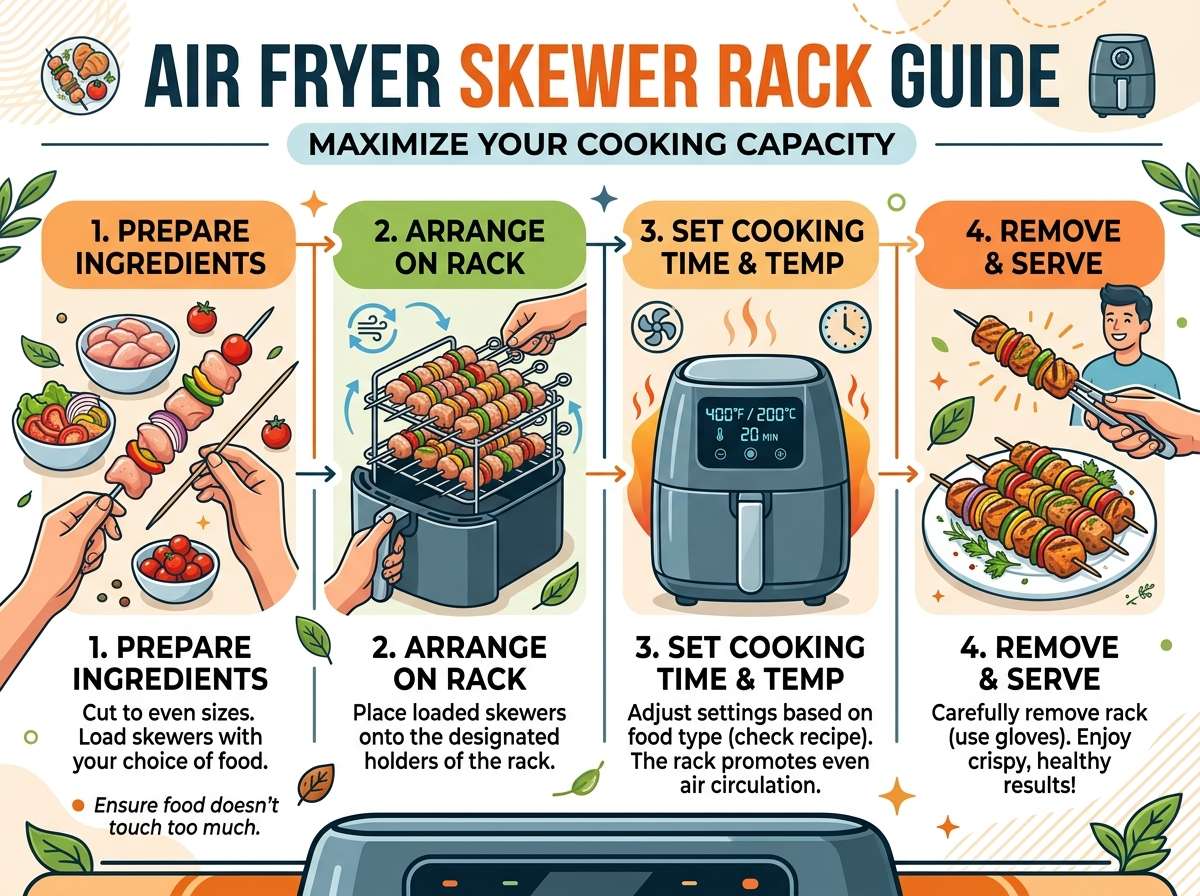
Using one of these racks is pretty simple once you get the hang of it. Here’s a step-by-step walk-through for beginners.
Step 1: Prep Your Ingredients
Cut your meat, seafood, or vegetables into evenly sized chunks. Uniform pieces cook at the same rate, so try to keep everything roughly the same size. Marinate ahead of time if you want extra flavor, and let the food sit for at least twenty minutes before cooking.
Step 2: Soak Wooden Skewers
If you’re using wooden skewers, soak them in water for about fifteen to twenty minutes before threading on your ingredients. This stops them from burning or catching fire inside the hot air fryer. Metal skewers skip this step entirely since they can handle heat without any prep.
Step 3: Thread the Skewers
Slide your ingredients onto the skewer, leaving a small gap between pieces so hot air can circulate. Packing everything too tightly blocks airflow and leads to uneven cooking.
Step 4: Load the Rack
Place each skewer into the rack’s slots or grooves. Make sure they’re evenly spaced and not touching each other. If you’re using a rotating model, double-check that the skewers are secured properly so they don’t fall during rotation.
Step 5: Set the Temperature and Time
Most skewers cook well between 375°F and 400°F. Cooking time depends on what you’re making, but a general range is ten to eighteen minutes. Chicken and thicker cuts of meat take longer than shrimp or vegetables.
Step 6: Check for Doneness
Use a meat thermometer if you’re cooking meat, especially chicken, to make sure it’s fully cooked through. Poultry should reach an internal temperature of 165°F, while beef and pork can vary depending on how well-done you like them.
Step 7: Rest and Serve
Let the skewers rest for a couple of minutes after cooking. This helps the juices settle back into the meat instead of running out the moment you take a bite.
Tips for Better Results
A few small adjustments can make a big difference in how your skewers turn out.
- Don’t overcrowd the rack. Leave breathing room between each skewer so hot air can move freely.
- Cut ingredients into similar sizes so nothing finishes too early or too late.
- Pat meat dry before threading it on, since excess moisture can lead to steaming instead of crisping.
- Brush a light coat of oil on vegetables to help them brown nicely.
- Rotate manually halfway through if you’re using a fixed rack instead of a rotating one.
- Preheat the air fryer for a few minutes before loading the rack, since starting with hot air speeds up browning.
- Avoid mixing ingredients with very different cook times on the same skewer, like raw chicken and delicate mushrooms.
Cleaning and Maintenance
Keeping your rack clean helps it last longer and keeps your food tasting fresh. If the rack is dishwasher-safe, that’s the easiest route. Otherwise, soak it in warm soapy water for about ten minutes to loosen any stuck-on bits, then scrub gently with a soft sponge.
Avoid using steel wool or harsh scrubbers on non-stick coated racks, since they can scratch the surface over time. For rotating models, wipe down the motor base with a damp cloth instead of submerging it in water, since the internal mechanism isn’t meant to get wet.
Dry the rack fully before storing it away. Leaving moisture on stainless steel can eventually lead to water spots or slight rusting near the joints.
Common Mistakes to Avoid
Even with a good rack, a few habits can hold back your results.
Overloading the basket. Cramming too many skewers in at once blocks airflow and leads to uneven cooking. It’s better to cook in two smaller batches than one overcrowded one.
Skipping the preheat. Cold starts mean your food spends more time in the “not quite hot enough” zone, which can leave the outside soggy instead of crisp.
Using wet wooden skewers without soaking. This is a common one. Dry wood can char or even catch fire under high heat.
Ignoring size differences. Mixing large and small pieces on the same skewer means one part finishes way before the other.
Forgetting to check for a snug fit. A rack that wobbles or doesn’t sit flat inside the basket can throw off cooking and even damage the appliance over time.
Frequently Asked Questions
Can I use metal skewers in every air fryer? Most air fryers handle metal skewers just fine, but always check that they don’t touch the heating element, since some models have less headroom than others.
Do I need a rotating rack, or is a fixed one enough? It really comes down to convenience. Rotating racks save effort, but fixed racks work just as well if you don’t mind flipping halfway through cooking.
What foods work best on an air fryer skewer rack? Chicken chunks, shrimp, beef cubes, bell peppers, onions, mushrooms, zucchini, and pineapple all turn out great. Basically, anything you’d normally grill on a stick works here too.
How long do skewer racks usually last? A well-made stainless steel rack can last for years with proper care. Cheaper coated versions may need replacing sooner if the non-stick layer starts to wear down.
Can I cook frozen meat on skewers directly? It’s best to thaw meat first. Frozen chunks cook unevenly and often leave the inside undercooked while the outside overcooks.
Final Thoughts
An air fryer skewer rack is a small investment that makes a noticeable difference in how your kebabs and grilled bites turn out. It saves time, cuts down on manual flipping, and gives you that crispy, evenly cooked result you’d normally only get from an outdoor grill. Once you get into the rhythm of prepping, loading, and cooking with one, you’ll probably wonder how you ever managed skewers without it.
If you’re cooking for one or feeding a whole family, this simple accessory turns your air fryer into a more versatile, grill-like tool right on your countertop. Give it a try with your next batch of kebabs, and you’ll likely notice the difference from the very first bite.

Mary is a home cooking enthusiast and kitchen appliance reviewer who loves helping people find the best tools for everyday meals. She enjoys testing air fryers, deep fryers, and other cooking appliances while sharing honest reviews and practical buying advice. Through FryerPick.com, Mary provides expert guides, product comparisons, and cooking tips to help readers choose the right fryer for their kitchen.