
Air Fryers vs Convection Ovens
If you’ve spent time scrolling through kitchen gadgets online, you’ve probably seen air fryers everywhere. They’re sleek. They’re small. They promise crispy food fast. But here’s the thing—a lot of people don’t realize that air fryers and convection ovens work pretty similarly. The differences are real, though. And we’re going to break them down in a way that makes sense.
Let’s dig into what makes these two appliances unique. We’ll look at how they work, what they’re good at, and which one might work better for your kitchen.
In this article
How Do Air Fryers Actually Work?
An air fryer sits on your counter like a small toaster oven. You fill a basket with food, close the drawer, and set the temperature and time. Then something interesting happens.
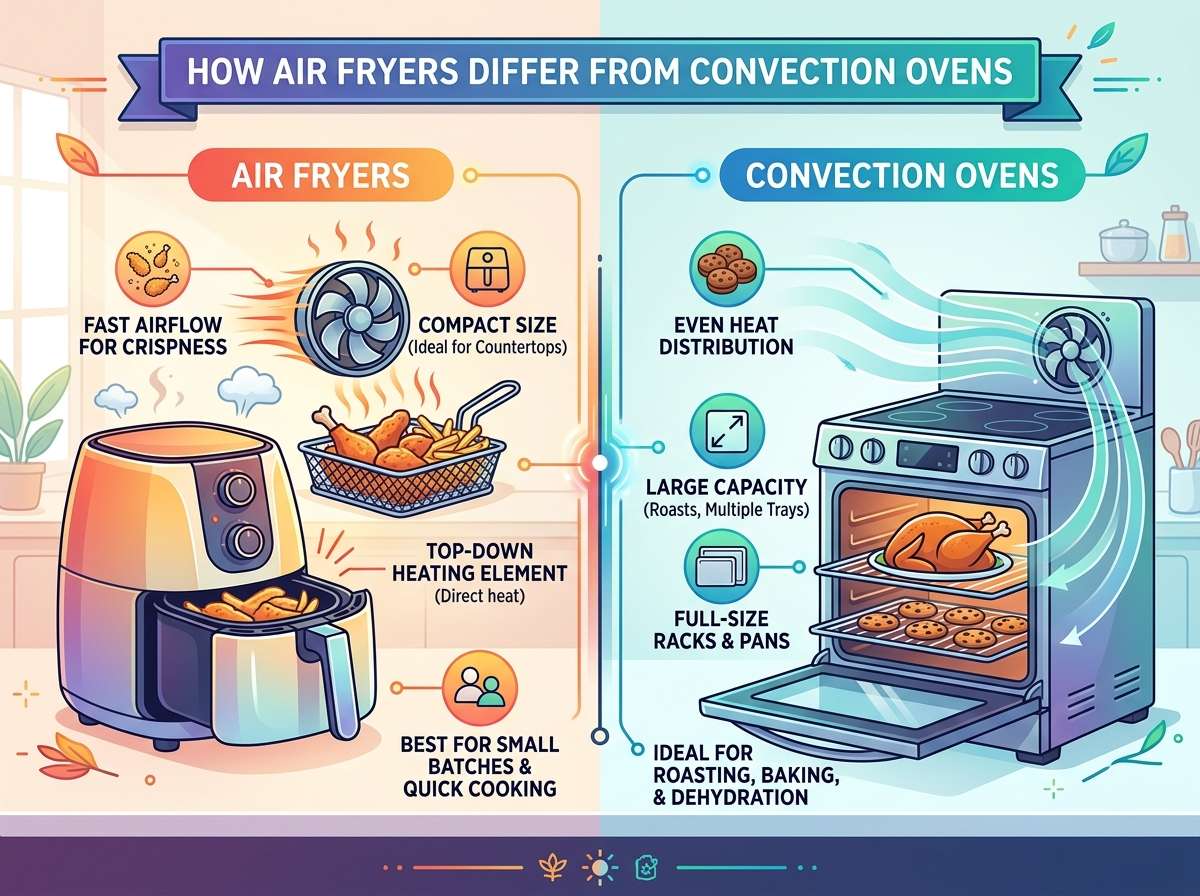
Inside the air fryer, a heating element sits at the top. It gets really hot—super fast. A powerful fan sits right near the heating element. This fan pushes the hot air down into the basket at high speed.
The hot air doesn’t just sit around your food. It moves fast. It swirls. It goes everywhere. Your food gets surrounded by this rushing hot air from every angle. The air hits your food, bounces off the basket, and hits the food again. This rapid air circulation does something important: it pulls moisture away from the surface of your food.
Without that moisture on top, something happens called the Maillard reaction. This is the science behind browning. Proteins and sugars react to the heat and create a golden, crispy layer. Your chicken gets crunchy. Your fries turn golden brown. Your vegetables get roasted to perfection.
The basket has holes in the bottom. Excess oil and moisture drip down through these holes. So even if you use a little oil, a lot of it doesn’t stick around on your food.
That’s the core magic of rapid air circulation cooking. It’s not actually frying with hot oil. It’s cooking with fast-moving air that removes moisture and creates that fried texture.
How Do Convection Ovens Work?
A convection oven looks like a regular oven. It sits in your kitchen taking up serious counter or wall space. But inside, there’s a key difference.
A regular oven has heating elements. That’s it. Heat gets trapped inside a box, and the temperature rises. The hot air sits there. Your food cooks because the oven got warm.
A convection oven has a fan. This fan is usually positioned near the back or side of the oven. The heating elements still do their job. But now the hot air doesn’t just float around. The fan pushes it around the oven.
The fan moves the hot air throughout the cooking space. It circulates. It prevents hot spots. Food cooks more evenly because the temperature stays consistent all around.
Convection ovens are bigger than air fryers. They heat slower because they have more space to warm up. But they can handle way more food at once. You can roast a whole chicken, bake cookies, and heat vegetables all at the same time if you arrange them right.
The Main Differences Between Air Fryers and Convection Ovens
Both devices use moving hot air to cook. But the differences matter. Let’s walk through them one by one.
Speed and Heating Time
Air fryers win on speed. Period.
An air fryer heats up in about two to three minutes. Sometimes even faster. You turn it on, set your temperature, and boom—it’s ready. The heating element is small. The space inside is tiny. Heat doesn’t have far to travel.
Once your air fryer is hot, cooking happens quick. A batch of frozen french fries takes about ten to fifteen minutes. Chicken breasts cook in twelve to eighteen minutes depending on thickness. Wings take about twenty minutes.
Convection ovens take longer to preheat. Most need anywhere from ten to twenty minutes to reach temperature. The space is bigger. It takes time to warm up all that air.
Cooking times in a convection oven are longer too. That same batch of frozen fries? It might take thirty minutes. Chicken could take thirty-five to forty minutes. You’re not just waiting for the food to cook. You’re waiting for the whole oven to heat, then waiting for the food.
This is why air fryers have exploded in popularity. People want dinner fast. An air fryer delivers that. You can have hot food on the table in twenty to thirty minutes total. With a convection oven, you’re looking at forty-five minutes to an hour.
Cooking Capacity
Convection ovens crush air fryers here.
An air fryer basket holds maybe three to four pounds of food comfortably. Most people cook for one to four people at a time. If you’re feeding a family of six, you need to cook in batches. First batch goes in. You wait. You take it out. Second batch goes in. You wait again. This adds time.
A convection oven has shelves. Multiple racks. You can load up several pounds of food. Cook for a big family all at once. Make multiple dishes simultaneously. Need to roast a whole chicken, bake vegetables, and heat rolls? A convection oven handles it.
If cooking for a crowd is your thing, a convection oven makes sense. If you’re cooking for one or two people, or you don’t mind cooking in batches, an air fryer is fine.
Food Quality and Results
Here’s where things get interesting. Both appliances can make food taste good. But they do it differently.
Air fryers create texture that’s hard to beat. The rapid air circulation pulls moisture so effectively that you get incredibly crispy results with minimal oil. Frozen foods come out crispy outside and hot inside. Vegetables get roasted and caramelized. Chicken skin gets crackling and brown.
The downside? Air fryers don’t handle wet batters well. You can’t pour batter for cookies or brownies. You can’t batter and deep fry things. You can’t make bread. The small space doesn’t handle moisture the same way.
Convection ovens cook differently. They roast. They bake. They brown things evenly. Because the heat moves slower and the space is bigger, food cooks more gently. This is great for baking. Cookies bake evenly. Cakes rise properly. You don’t get hot spots where one side burns and the other side is underdone.
For crispy stuff, convection ovens work but not quite like an air fryer. You might need more oil. Cooking takes longer. The results are good but not as intensely crispy.
The best cooking results depend on what you’re making. Want crunchy fries and crispy chicken? Air fryer wins. Want to bake cookies, roast a whole meal, or make casseroles? Convection oven is better.
Countertop Space
Air fryers are small. Really small. They sit on your counter and take up minimal space. If you live in an apartment, have a small kitchen, or just don’t want a huge appliance taking up real estate, an air fryer fits easily.
Convection ovens range from medium to large. Even the compact ones need significant counter space. If your kitchen is cramped, a convection oven is tough to fit.
For apartments and small kitchens, an air fryer is the practical choice.
Price and Cost
Air fryers range from about fifty dollars for basic models to three hundred dollars for premium versions. Most people find good quality air fryers in the hundred to two hundred dollar range.
Convection ovens start around one hundred dollars and go up to six hundred or more. If you’re replacing a regular oven with a convection oven, you might spend two thousand dollars for installation.
For budget-conscious shoppers, an air fryer is cheaper upfront. This makes them accessible to more people.
Energy Efficiency
Air fryers win on energy use. The small heating element and enclosed space mean less energy wasted. Your electricity bill goes down. Heat doesn’t escape. Cook time is quick. Lower energy consumption overall.
Convection ovens use more energy. Bigger space to heat. Longer cooking times. More electricity consumed. This adds up on your electric bill over time.
If saving on utilities matters to you, an air fryer is smarter.
What Can You Cook in an Air Fryer?
Air fryers are fantastic for lots of foods. Let’s talk about what works best.
Frozen foods cook beautifully in air fryers. French fries, chicken nuggets, fish sticks, mozzarella sticks, frozen vegetables—all come out crispy and hot. This is where air fryers shine.
Fresh vegetables roast wonderfully. Broccoli, brussels sprouts, carrots, zucchini, bell peppers—toss them with a little oil and seasoning, and they get caramelized and delicious in minutes.
Proteins work great. Chicken breasts, thighs, wings, drumsticks, pork chops, fish fillets, shrimp—all cook evenly and get golden brown.
Leftovers reheat amazingly. That pizza from two days ago gets crispy again, not soggy. Fried chicken reheats and stays crunchy. This is something air fryers excel at.
Snacks turn out fantastic. Homemade chips, kale chips, chickpeas, nuts roasted with spices—all work.
What doesn’t work? Anything wet. You can’t cook soup. You can’t batter things like traditional fried fish. You can’t make bread or baked goods. You can’t do casseroles with lots of liquid.
What Can You Cook in a Convection Oven?
Convection ovens handle a wider range of foods because they’re more versatile.
Baking is where they excel. Cookies, cakes, muffins, brownies, pastries—all bake evenly. The circulating air prevents hot spots.
Roasting works beautifully. Whole chickens, turkeys, roasts, vegetables—everything roasts evenly and gets tender and golden.
Multiple dishes cook simultaneously. Need to roast vegetables, cook chicken, and heat bread? Do it all at once on different racks.
Casseroles and baked dishes with liquid turn out great.
Bread bakes properly with good crust and rise.
Delicate foods cook gently. The slower heat is better for things that need tender handling.
The convection oven is a workhorse. It handles almost anything a regular oven can do, just faster and more evenly.
Air Fryer vs Convection Oven: Head to Head
Let’s compare directly across important categories.
Speed: Air fryer wins. It heats faster and cooks faster.
Capacity: Convection oven wins. It cooks way more food at once.
Crispiness: Air fryer wins. The rapid air circulation creates unmatched crispiness.
Baking: Convection oven wins. Better for breads, cakes, and cookies.
Versatility: Convection oven wins. It handles more types of food.
Space requirements: Air fryer wins. Takes minimal counter space.
Price: Air fryer wins. Generally cheaper to buy.
Energy use: Air fryer wins. More efficient.
Even cooking: Tie. Both do this well.
Cooking texture variety: Convection oven wins. It can roast gently or bake, creating different textures.
Should You Get an Air Fryer or Convection Oven?
This depends on your situation. Let’s break it down.
Get an air fryer if:
You live alone or cook for one to two people. You love crispy foods and quick meals. You have limited counter space. You want to save money on electricity. You eat a lot of frozen foods or leftovers. You want simple, fast cooking without complicated prep. You’re on a tight budget for appliances.
Get a convection oven if:
You cook for a large family regularly. You like baking. You want versatility in what you can cook. You don’t mind the counter space. You cook whole meals with multiple components. You want to avoid cooking in batches. You bake bread or make pastries often.
Get both if:
You have the space and budget. Use the air fryer for quick meals and reheating. Use the convection oven for baking and big meals. They work together beautifully.
Common Misconceptions About These Appliances
Let’s clear up some confusion that exists out there.
“Air fryers are just convection ovens in a small package.”
This isn’t totally wrong, but it’s not totally right either. Both use moving air. But air fryers have higher air velocity. The rapid circulation and smaller space create different results. Convection ovens cook more gently. The difference matters.
“You can’t use oil in an air fryer.”
You can use a little oil. Zero oil? Food can stick or dry out. A light spray or coating of oil works great. You just use way less than traditional frying.
“Convection ovens heat food with convection, but air fryers heat food with hot air.”
Both heat with hot air. The difference is speed and intensity of circulation. Air fryers circulate faster.
“Air fryers are healthier because they fry without oil.”
Healthiness comes from overall diet and food choices, not the cooking method. You can make unhealthy food in an air fryer. You can make healthy food in a convection oven. The appliance doesn’t determine health.
“Convection ovens are better for everything.”
Nope. Air fryers are better at certain things, especially creating crispy texture fast. Convection ovens are better at others, like baking. Neither is universally superior.
Making the Most of Your Air Fryer
If you go with an air fryer, here’s how to get the best results.
Don’t overcrowd the basket. Food needs space for air to circulate. A full basket means uneven cooking.
Shake or flip food halfway through. This helps with even browning.
Pat food dry before cooking. Moisture on the outside gets in the way of crispiness.
Use a light spray of oil for better browning.
Preheat when you can, especially for baking.
Start with less cooking time. You can always add more time. You can’t undo overcooked food.
Read your specific air fryer manual. Different brands and models vary slightly.
Making the Most of Your Convection Oven
If you choose a convection oven, follow these tips.
Lower your oven temperature by twenty-five degrees compared to regular oven recipes. Convection ovens cook faster.
Reduce cooking time by ten to fifteen percent.
Use the oven light to check on food without opening the door.
Arrange racks so air can circulate around all food.
Don’t block air vents with pans.
Use light-colored pans. They cook more evenly than dark pans in convection ovens.
Let larger items like whole chickens get closer to the heating element for better browning.
The Bottom Line
Air fryers and convection ovens are different tools for different jobs.
Air fryers are fast, small, crispy-making machines. They’re perfect for quick meals, frozen foods, and people who want their dinner in thirty minutes. They use less electricity and take up minimal space.
Convection ovens are versatile workhorses. They handle big meals, baking, roasting, and multiple dishes at once. They’re better if cooking for crowds is your thing.
The choice comes down to your lifestyle. What do you cook most? How many people do you feed? How much counter space do you have? What’s your budget?
You might not need to choose. Many people use both appliances. An air fryer for quick weeknight dinners. A convection oven for weekend cooking and baking.
Both appliances make better food than regular ovens or stovetop cooking alone. Both are worth consideration. You just need to pick the one that fits your needs.
Start with what makes sense for your kitchen and your cooking style. You might be surprised at how much better your food tastes and how much time you save.

Mary is a home cooking enthusiast and kitchen appliance reviewer who loves helping people find the best tools for everyday meals. She enjoys testing air fryers, deep fryers, and other cooking appliances while sharing honest reviews and practical buying advice. Through FryerPick.com, Mary provides expert guides, product comparisons, and cooking tips to help readers choose the right fryer for their kitchen.


2 Comments